(214) 466-7391


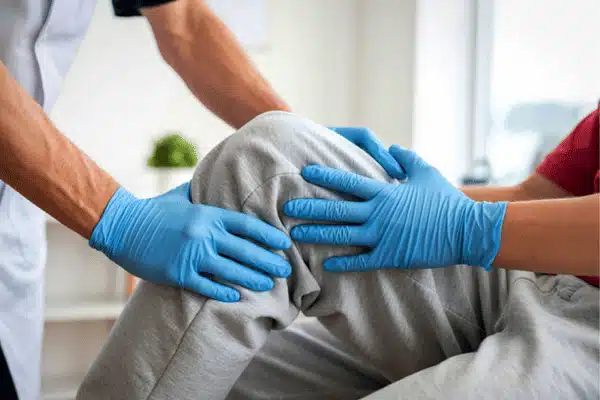
Knee pain can stop you cold. Whether it happened during a sport or crept up over time, a thorough knee examination is the first step toward answers. At your first visit with an orthopedic knee specialist, your doctor does far more than press on your knee and send you home. This guide walks you through exactly what to expect so you walk in prepared and walk out with a clear plan.

A knee examination has three main parts: history, physical exam, and imaging if needed. Your joint doctor uses each step to narrow down the cause of your pain.
The goal is simple: find out what is wrong and how to fix it.
According to the American Academy of Family Physicians (AAFP), a complete knee physical exam is over 80% sensitive for detecting ACL tears when done correctly.
Before touching your knee, your doctor will ask questions. Be ready to answer:
Tip: Wear shorts or bring a pair. Your doctor needs full access to your knee.
Your doctor looks at your knee before touching it.
Your doctor bends and straightens your knee.
This is where knee exam maneuvers help.
Your doctor also checks pulses, sensation, and reflexes.
This is the heart of any orthopedic knee evaluation. Your doctor works through several steps.
Your doctor looks at your knee before touching it. They check for:
Next, they feel along the joint line, the kneecap, and the surrounding tissues. They check for warmth, tenderness, and fluid buildup.
Your doctor bends and straightens your knee. Normal flexion is around 135 degrees. Limited motion points to swelling, tightness, or structural damage.
This is where knee exam maneuvers help. Your doctor may use tests such as the Lachman and anterior drawer to check ACL stability, valgus and varus stress to assess the MCL and LCL, and McMurray's or Thessaly to look for signs of a meniscus tear. A patellar apprehension test may also be used to check kneecap instability, especially if the knee feels like it may slip out of place.
Your doctor also checks pulses, sensation, and reflexes. This rules out nerve or blood vessel problems.
Red Flags That Need Urgent Care
Tell your doctor right away if you have:
Not every knee examination needs imaging right away. But some findings point to it.
The American College of Radiology (ACR) recommends X-rays as the first imaging step for most knee pain cases, especially chronic pain.
Your doctor may order imaging if they find:
MRI is highly accurate for soft tissue injuries. Research shows it detects medial meniscus tears with about 93% sensitivity (NIHR, 2015).

Your knee specialists will review findings and explain what comes next. Common paths include:
In the US, 20% of adults have arthritis, and that number rises to over 54% for those 75 and older (CDC, 2024). Early assessment by knee specialists before symptoms worsen is beneficial to many.
Are you prepared to receive answers? Schedule a knee exam with one of our orthopedic knee specialists right now. A quicker recovery is possible with an early diagnosis.
Most parts of the exam are not painful. Some special tests may cause mild discomfort, especially if you have an existing injury. Your doctor will stop if pain becomes severe.
Most first visits last 30 to 60 minutes. This includes your history, the physical exam, and time to discuss findings and next steps.
No. Your joint doctor will decide if imaging is needed based on your exam. Many diagnoses are made from history and physical findings alone.
Yes. Virtual visits work well for initial evaluations. Your orthopedic knee specialist near me can review your symptoms, watch how you walk, and guide you through self-tests like the Thessaly test via video.
A joint doctor is a general term for any physician who treats joint problems. An orthopedic specialist focuses on the musculoskeletal system, including bones, ligaments, and cartilage.
Bring a list of your current medications, any prior imaging, and a clear description of when the pain started. Wear or bring shorts for easy access to your knee.
Early diagnosis is crucial. Experienced orthopedic specialists treat patients at Sunnyvale Orthopedics using comprehensive examinations, cutting-edge imaging, and tried-and-true treatment regimens to provide precise answers and long-lasting outcomes. Evidence-based care, individualized treatment, and assisting patients in safely and confidently returning to full function are the main priorities of their team.
Stop guessing what’s causing your knee pain and get real answers from specialists who treat it every day. Book your knee examination with Sunnyvale Orthopedics now and take the first step toward a faster, stronger recovery.