(214) 466-7391


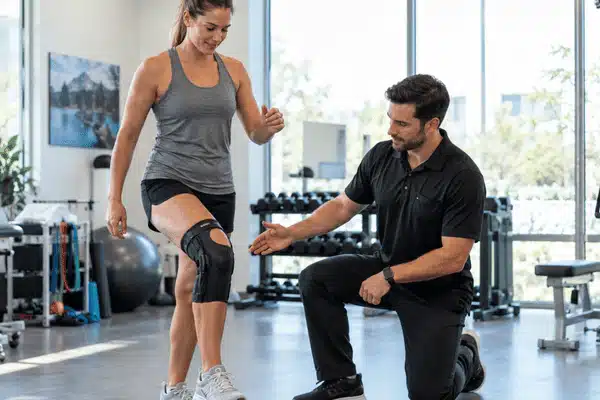
ACL surgery recovery time is not the same for everyone. Some people are moving around well within a few weeks. Others need more time, especially if the injury involved more than the ACL.
Running usually comes later in rehab. Sports such as soccer, basketball, and football take even longer because they involve cutting, jumping, and quick changes in direction. For many athletes, that means waiting nine to 12 months before a full return.
A scoping review of 201 studies found that the most commonly reported clearance point for running was a median of 12 weeks after surgery, yet fewer than one in five of those studies reported any clinical, strength, or performance criteria at all.
A knee injury specialist does not look at the calendar alone. Swelling, strength, knee motion, balance, and control all help show how well recovery is going.
Walking around the house and returning to sport are very different recovery goals. That is why ACL rehab is usually broken into stages.
Here is a rough timeline:
| Recovery Goal | Common Timeframe |
| Walking with less support | First few weeks |
| Driving after right-knee surgery | About 4 to 6 weeks |
| Starting a running program | Around 3 months or later |
| Returning to cutting or pivoting sports | Often 9 to 12 months |
These dates are not deadlines. Some people reach a milestone sooner. Others take longer because of swelling, weakness, limited motion, or another knee injury.
It also helps to set expectations about the destination, not just the route. A systematic review and meta-analysis of return-to-sport outcomes found that 81 percent of patients returned to some form of sport, 65 percent returned to their preinjury level, and 55 percent returned to competitive sport.
The American Academy of Orthopaedic Surgeons recommends checking knee function before an athlete returns to sport. Strength and movement tests can help with that decision.
There is also a good reason not to rush. A 2020 study in the Journal of Orthopedic & Sports Physical Therapy found more second ACL injuries among young athletes who returned before nine months.
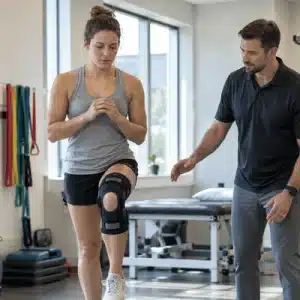
An ACL reconstruction protocol usually starts with basic goals. Early on, the focus is getting swelling down, straightening the knee, and waking the thigh muscles back up.
As the knee improves, the work gets harder.
Aspetar’s ACL rehab guideline supports using recovery goals before a person starts running. The knee should have good motion, little swelling, and enough strength.
The guideline, published in the British Journal of Sports Medicine in 2023, also asks athletes to restore their own preoperative absolute strength values where those are known, rather than relying on side-to-side symmetry alone. Symmetry can look healthy when both legs have lost strength.
The timeline is only part of the plan. Two people can be three months out from surgery and still be at very different stages.
An ACL and meniscus surgery recovery timeline depends a lot on what happened to the meniscus.
Sometimes, damaged tissue is trimmed. In other cases, the meniscus is repaired and needs more time to heal.
Combined injuries are the rule rather than the exception. Lateral meniscus damage is present in more than half of acute ACL ruptures, while medial meniscus involvement is more common in knees that have been ACL-deficient for a longer period.
The 2024 EU-US Meniscus Rehabilitation Consensus notes that not every repair needs the same restrictions. Some stable vertical repairs may barely change the ACL rehab plan. Other repairs can require limits on knee motion or weight-bearing for several weeks. The consensus, run jointly by ESSKA, AOSSM, and AASPT and published in 2025, sets out how far apart those plans can be:
Recovery may be slower after:
This is why one timeline cannot apply to every patient with both ACL and meniscus damage.
An ACL tear does not always lead to surgery. Some people regain good function through physical therapy and changes in activity.
Torn ACL recovery time without surgery depends on how stable the knee feels and what the person wants to get back to.
ACL reconstruction and exercise-based rehabilitation were examined in a 2025 review published in Sports Medicine. There was no discernible variation in return-to-sport rates, according to researchers. They also pointed out that the quality of the evidence was poor or extremely poor.
Rehab without surgery may make sense when:
Surgery may become more likely when the knee keeps giving way. It may also be considered for athletes who want to return to sports with sharp turns, jumps, or fast direction changes.
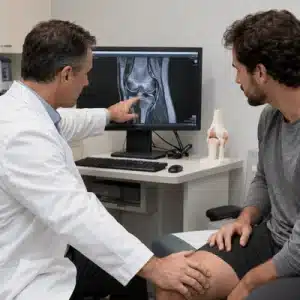
The choice between ACL repair vs reconstruction depends on the tear and the condition of the remaining ligament.
ACL reconstruction uses a graft to replace the torn ligament. It is still the most common operation for an ACL tear.
ACL repair tries to keep more of the original ligament.
The BEAR Implant from Miach Orthopaedics is one example. Instead of replacing the ACL with a graft, it is designed to help the torn ligament heal.
It received De Novo authorisation from the US Food and Drug Administration in December 2020 for complete ACL tears in skeletally mature patients aged 14 and older who still had an ACL stump attached to the tibia. On 10 March 2025, the FDA cleared an expanded indication that includes partial tears and children and adolescents of any age, provided there is enough bone in the femoral and tibial epiphyses to avoid disturbing the growth plates.
BEAR is not an option for every injury. The tear itself, remaining ACL tissue, age, other knee damage, and activity goals all matter.
A knee surgeon can review those details and explain which option is more suitable.
Many athletes need around nine to 12 months before returning to pivoting sports. Some need longer. The final decision should also include strength and movement testing.
Many people begin walking with crutches soon after the operation. How much weight you can put on the leg depends on the procedure. A meniscus repair may change those instructions.
Six months may still be too early for demanding sports. Young athletes have shown a higher risk of another ACL injury when they return too soon. Strength and movement quality should also be checked.
No. Some people do well with physical therapy alone. Surgery is more likely when the knee remains unstable or repeatedly gives way.
Running often begins around three months or later. Before that happens, the knee should move well, have little swelling, and regain enough strength. Your rehab team should decide when running is safe.
Not everyone does. AAOS guidance does not support routine functional bracing after an isolated primary ACL reconstruction. A brace may still be used when another injury or procedure calls for it.
ACL recovery does not follow one exact schedule. Walking may come back fairly quickly, while running and sports take much longer. What matters most is how the knee is moving, how strong it feels, and what activities you want to return to.
If you have an ACL injury in Sunnyvale or East Dallas, book an appointment with Sunnyvale Sports Medicine and Orthopedic Center for a knee evaluation and a recovery plan that fits your needs.